
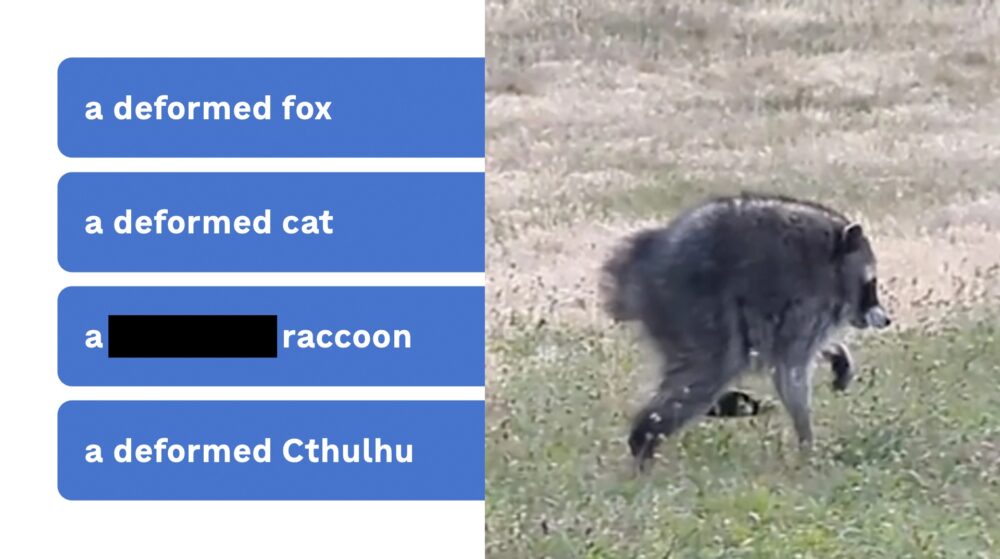
Last week we found a lesson about belonging from a world-famous soccer player. This week, we found one with a world-famous raccoon.
Hopefully you’ve seen Jimothy by now. If not, check out this week’s newsletter image. That’s him. He’s a young raccoon with a family and community that love him, and he’s world famous because he’s unique.
What makes him unique is a rare condition called short spine syndrome. His front legs (arms?) are actually normal length. But they appear elongated because his spine is so short.
Often in the animal kingdom, and sadly too often with humans, individuals with physical differences are ostracized, neglected, or attacked. Jimothy could’ve suffered that fate. But his family and community accepted him, stayed close to him, and made him feel like he belongs.
The Power of our Words
The words being used to describe Jimothy reminded me that language is essential to cultivating belonging. That’s true for any gathering, and especially for in-person ones. In prior newsletters, we’ve focused on making sure people can see and hear what’s being said during meetings. But that access is just step one for belonging. The words we choose are the next step.
This week’s newsletter image includes a screenshot of a multiple choice item from NPR’s weekly news quiz that was about Jimothy. Their headline and item describe him as “deformed.” That’s not a word that cultivates belonging. It implies inferiority, not just difference.
It’s the same dynamic I shared last week, when Argentine sports journalist Flavio Azzaro called Messi “European” rather than Argentine. That word didn’t affirm Messi’s belonging on the Argentine national team. It implied he didn’t fully measure up as one of their own.
Three Ways to Choose Belonging-Focused Language
While Jimothy and Messi are high-profile examples, all of us can choose language each day that affirms each person’s humanity, each individual’s value, and helps them feel a true sense of belonging. Here are three simple shifts in language I’ve experienced firsthand.
1. Avoid deficit-framing that implies inferiority
When couples don’t have children, the default word used to describe them is “childless.” That implies something is missing or lost. Couples that have chosen not to have kids prefer being described as “childfree” instead. And for couples who wanted to have biological children and couldn’t have them, neither term may feel right. The kindest approach is often to simply not center their status in this area as a topic at all. But if it comes up, avoid deficit framing.
I once highlighted the distinction between “childless” and “childfree” during a company meeting about using inclusive language to improve company culture. Afterward, a colleague who had been quietly trying to conceive for years told me how much it meant to him that our company and colleagues were learning to think this carefully about language. He hadn’t shared his own experience with me before that moment, but he felt more room to be himself once he saw we were paying attention.
2. When someone tells you who they are, believe them
A few years ago, I was picking up my son from a party at his middle school and was also carpooling to drive home a neighbor’s child I hadn’t met before. When they got in the car, I greeted them by the girl’s name I’d been given in advance by my neighbor. They replied, “Actually, I go by Grant, and I identify as a boy.”
I said, “Nice to meet you, Grant! How was the party?” and moved right along.
It was easy to get on board immediately because when one of my best friends shared his son was trans, the next thing he told me was that when parents and adults immediately accept a young trans person’s identity, their risk of dying by suicide drops significantly. Belonging and acceptance are the key factors. There was no reason for me to hesitate on using Grant’s name right away.
In that moment in the car, my own son was great about it. He looked genuinely puzzled for a second, verbally walked through his understanding of Grant’s situation, and then said, “That’s confusing.” I told him, “Sounds like you understand it perfectly and aren’t confused at all!”
I later learned Grant hadn’t told his parents yet. Maybe it was easier to try telling someone he barely knew first to build up some courage. His parents, when he did tell them, were instantly accepting as well.
3. Center people’s humanity before their circumstances
In general, cultivating belonging means using language that leads with a person’s humanity rather than an adjective that defines them. For example, it’s better to say “people with disabilities” instead of “the disabled.” This can take practice because it runs counter to historical and learned language habits. It’s also better to avoid using adjectives that imply inferiority, such as saying “people who are unhoused” instead of “the homeless.”
Some of these preferences aren’t universal, even within the communities they describe. And they can change over time as language and learning evolve. For example, some people prefer identity-first language like “blind person” over the person-first phrasing “person who is blind.” There’s no single rule with a fixed formula about language, but defaulting to person-first framing is an important step towards establishing your own new language habits.
The real single rule is to put people and belonging first.
That means using the language a community or individual actually prefers, asking when you’re not sure, and helping the people in your sphere of influence choose language that doesn’t make others feel like outsiders or lesser than.
Like I said in last week’s newsletter, cultivating belonging is the job of the people leading the room. Understand who’s in the room. Know what makes people feel welcome and included.
Jimothy didn’t choose his differences and neither does anyone else. But everyone around him chooses their words. That choice is always ours to make. Choose the language of belonging.
In the next issue…
We’ll look at the cognitive science behind why belonging is the foundation for success when people get together. The organizations that design for real belonging will have the greatest success.
Have a gathering that went surprisingly well — or one that taught you something the hard way? We’re always looking for stories and voices to feature in Gathering Points. Reach out any time.
Get the next issue of Gathering Points.