
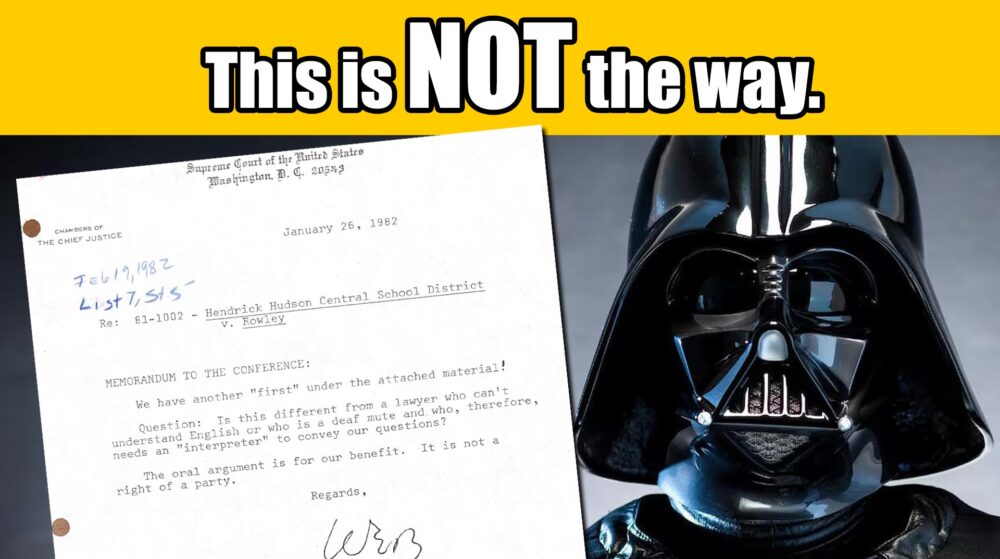
Huge disappointment to have recently learned that in 1982 the Chief Justice of the Supreme Court, Warren Burger, denied a deaf lawyer’s request for real-time transcription when arguing a case at the Court (Hat tip to Sam Bagenstos for surfacing this). You can see Burger’s memo in this week’s newsletter image. The lawyer had lost his hearing as an adult, so he could speak, but had not yet learned ASL or lip reading.
What’s wilder is that (1) the lawyer intended to pay for the transcription himself, and (2) the case was about disability access – the lawyer was arguing that a school district should be required by law to provide an ASL interpreter for a fourth-grade student under an education law passed in 1975.
Here’s what Chief Justice Burger’s memo said:
MEMORANDUM TO THE CONFERENCE: We have another “first” under the attached material! Question: Is this different from a lawyer who can’t understand English or who is a deaf mute and who, therefore, needs an “interpreter” to convey our questions? The oral argument is for our benefit. It is not a right of a party.
I hate it.
My top three reasons:
1. He Designed for the Best Seats in the House
In the first issue of Gathering Points, I wrote, “Most events are planned for what gets said, not for who’s listening.” Chief Justice Burger explicitly says in the last sentence that the format of the oral arguments is only for the Justices, not the lawyers. In his mind, he doesn’t care if the lawyer arguing the case can’t fully engage and participate. He had no interest in or intention of eliminating barriers. He designed the experience for the people at the bench, not the people at the bar.
2. He Believed in Such a Thing as Over-Compensating for Guests
Unlike Parkway Schools who went above and beyond as I described last week, Chief Justice Burger was looking for any reason not to meet the needs of everyone participating at the Supreme Court. Instead of having a default position of seeking to accommodate the needs of a key participant in the oral arguments (a lawyer!), Burger actively sought out reasons that would prevent him from meeting this need. When you’re looking for a reason not to care, any reason will do.
3. He Violated His Oath to Uphold Justice
As the highest court in our land, the Supreme Court of all places should do everything possible to ensure justice is served. That includes creating the conditions for a fair hearing of the facts. It’s fundamentally unjust and unfair if one party’s lawyer is unable to hear or understand the questions asked by the Justices. Perhaps Burger would have argued that they should use another lawyer who didn’t need transcription. But the party should have the option to choose the best lawyer for their case. I also take issue with Burger’s belief that language accommodations for non-English speakers shouldn’t be accommodated. If justice being served requires an interpreter, then so be it.
In a just world, accessibility and language shouldn’t be a barrier at any live event, and especially those as important as oral arguments before the Supreme Court.
The good news is that Burger’s denial was temporary. Ultimately, the first deaf lawyer to argue before the U.S. Supreme Court, Michael A. Chatoff, was provided with a monitor showing the justices’ questions. A stenographer typed the Justices’ questions, which Chatoff could then read on the monitor before responding verbally. You can learn more here.
Though Chatoff had won the case in two lower Federal courts, the Supreme Court ruled the other way. The school district argued that they had already provided several accommodations and tools for the student, and she was performing above average for her class. They also argued that providing an interpreter for one deaf student would require interpreters to be provided for all deaf students. Such a requirement would be financially impossible for the district. At the time in 1982, the cost of a full-time ASL interpreter was $20,000-$25,000 per year.
In the next issue…
Gathering Points will take a week off next week for the 4th of July holiday. Having discussed visual and hearing accommodations in the past two issues, when we return the week of July 13, we’ll take a deeper look at how language accommodations at in-person events drive a deeper sense of belonging and connected communities.
Have a gathering that went surprisingly well — or one that taught you something the hard way? We’re always looking for stories and voices to feature in Gathering Points. Reach out any time.
Get the next issue of Gathering Points.