
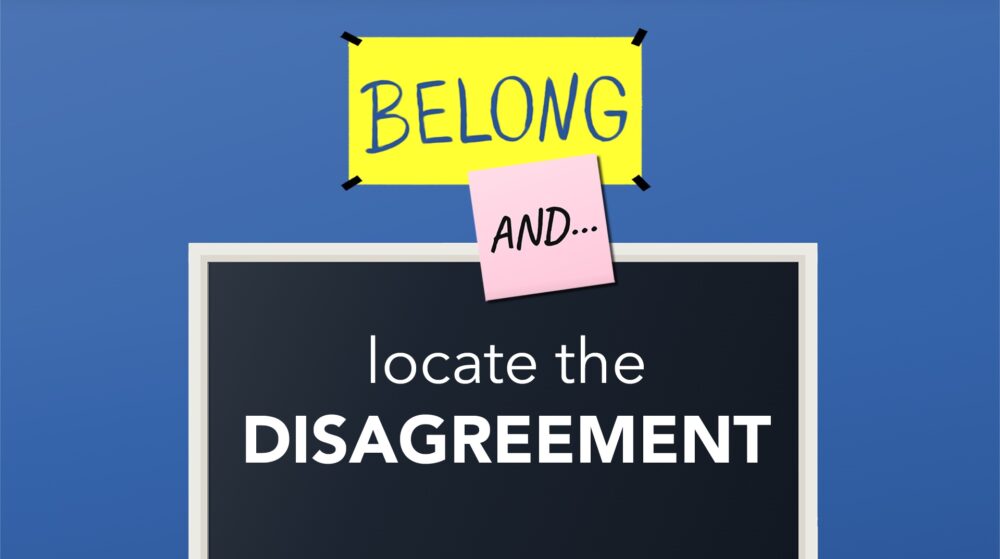
At some point, there will be disagreement within our groups and on our teams. You may have heard “Disagree and Commit” as a popular phrase for moving forward when that happens. Attributed to Scott McNealy at Sun Microsystems in the 1980s, Andy Grove at Intel, and Jeff Bezos at Amazon, the phrase is meant to give teams a way to move forward without requiring consensus while keeping everyone rowing in the same direction once a decision has been made.
But not all decisions are equal.
So, as I shared last week, the most important thing to do when disagreements arise is to identify at which strategic level the disagreement is located:
- Diagnosis of the Challenge to Overcome
- Guiding Policy, or
- Coherent Action
Any decision to “Disagree and Commit” in service of team alignment that doesn’t name the level and the exact disagreement hurts morale and is a recipe for disaster.
Our examples from last week are illustrative. For Argentina’s men’s national soccer team, I don’t know the details of how Lionel Scaloni secured the Head Coach position, but my guess is that it helped that he had a novel, convincing strategy for turning things around, starting with the Diagnosis level. The Argentine Football Association that hired Scaloni presumably knew his 1, 2, and 3 and “Agreed and Committed” to his approach. For Scaloni to execute at levels 2 and 3, I’m also guessing there were some hard decisions to make about the roster. Imagine a player who disagreed at the Diagnosis level – he didn’t think a team member’s identity and sense of belonging mattered, let alone that it was a problem. Asking that player to “Disagree and Commit” would have undermined the entire strategy.
Nikole Hannah-Jones and her daughter Najya both agreed at levels 1 and 2, but not at 3. A Guiding Policy can be true without requiring that a particular (and personal) Coherent Action be taken. The tension is that Najya was a child without full understanding of the strategy who was too young to commit, let alone be given the option to “Disagree and Commit.” And indeed, when she was old enough and understood enough to question her parents’ decision and voice her disagreement, Hannah-Jones did not force Najya to “Disagree and Commit.” Instead, due to her daughter’s disagreement, she changed one of her Coherent Actions and allowed Najya to choose her own school.
As you might notice, in these instances, “Disagree and Commit” never happened. But that’s part of the point. For Argentina, disagreeing at the Diagnosis level meant a player couldn’t be on the team. For Hannah-Jones, disagreement with a Coherent Action warranted a change of action.
For your team or situation, the stakes might not be as high as these examples. Maybe a Coherent Action is holding an event, and there’s disagreement about whether to provide swag or where to hold the event. But in other cases, your team and goals may be harmed simply by accepting “Disagree and Commit” without articulating the strategic level where the disagreement lives.
So have that hard conversation about where the disagreement lives.
At the very least, it will sharpen your strategy while ensuring everyone in the group is aligned. You might also surface new options and improvements to elements of your strategy. Or perhaps some people don’t continue with the group because there’s no way to truly be committed given the level of disagreement. While these outcomes may feel good or bad, the group’s goals are more likely to be achieved with higher team morale when the team is rowing in the same direction.
In the next issue…
Often, the teams where a lot of “Disagree and Commit” is happening are also groups where some people feel like they’re wasting time because decisions aren’t being made fast enough. Your best chance for tackling both problems is to build your strategy and make decisions with a clear process and give every meeting a defined purpose. If you think “process” implies “slow,” it doesn’t have to be that way. Deliberate and intentional aren’t the opposite of quick. In fact, if you don’t have time to do something right, you’d better have time to do it twice.
So next week I’ll focus on the importance of being explicit about the point of your in-person gatherings. When you set the right expectation for your time together, you’ll accomplish more and improve morale.
Have a gathering that went surprisingly well — or one that taught you something the hard way? We’re always looking for stories and voices to feature in Gathering Points. Reach out any time.
Get the next issue of Gathering Points.