
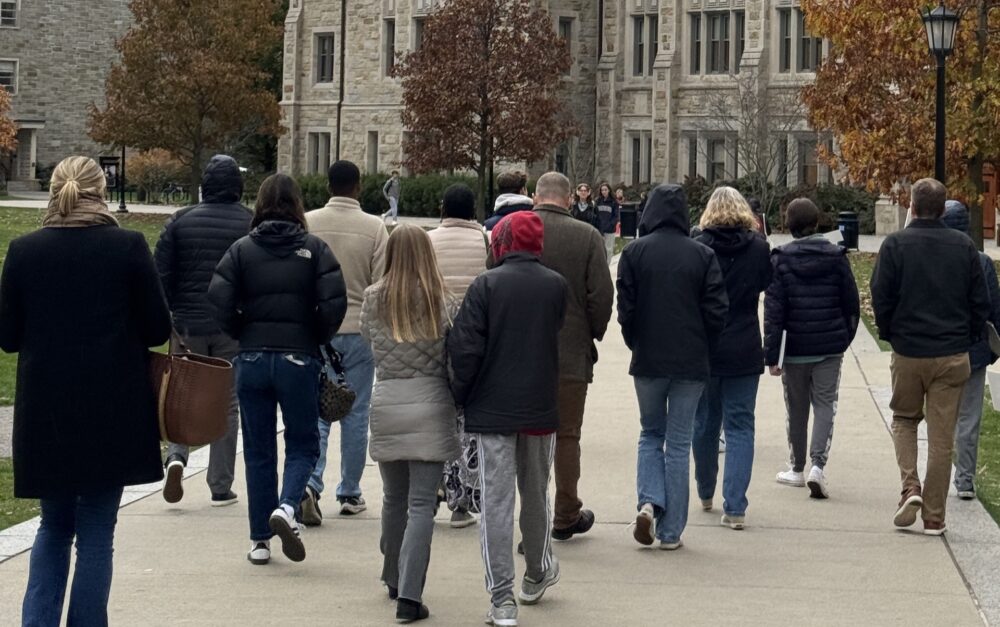
It hit me while visiting colleges with my wife and son (that’s him in the red hat).
We sat through information sessions and guided tours at three well-regarded schools in two days. Some had three families in the room. Some had thirty. The admissions officers were passionate, the tour guides were earnest, the material mattered, and everyone had made the effort to show up. But something was off.
I kept noticing patterns: people were present without really participating. Questions went unasked. Details got lost. I couldn’t always hear the guide. At times it felt like a museum tour; very sit-and-get, show-and-tell. Five minutes into each tour I had forgotten our tour guides’ names, and some of the guides never even learned ours. And within an hour of leaving, we’d already forgotten most of what was covered.
If I was feeling disconnected, how was everyone else feeling? And while I’m fortunate to hear well, see well, and speak English, what would I have done if I didn’t hear well or spoke another language? And as I thought beyond just these visits, I realized these same problems and questions apply to just about every in-person event I’ve ever been to.
Most events assume that being in person is enough. But presence alone can’t drive participation.
From college info sessions to corporate all-hands to professional conferences to PTA meetings, too many gatherings still run on the same basic formula: a microphone, a slide deck, a room full of people, and the hope that proximity will do the rest.
A packed room can still leave people disconnected. A great speaker can still miss the questions people were too shy to ask in front of everyone else. A language barrier can leave someone sitting right there, completely uninvolved. And most of us forget what was covered within minutes of walking out the door.
If it’s worth getting together, then it’s worth having more than just a mic and a PowerPoint.
The opportunity in front of us is to ask what gatherings could become if we stopped overestimating what physical proximity delivers by default and started designing intentionally for universal participation, better memories, and real connection. How amazing would it be if we made sure no one’s inclusion or participation were an after-thought?
Most events are planned for what gets said, not for who’s listening, because inertia has been stronger than imagination.
Until now.
This is why we started Gathering Points. It’s a space for shared learning as we find better ways to design events where everyone can ask, respond, connect, contribute, belong, and remember. Where people leave an event not just having been in the room, but having been a meaningful part of what happened there.
This space is for event designers, educators, community builders, meeting organizers, and anyone who believes that gathering in person should mean something more than filling a room, doing a mic check, and running through the slides. We’ll explore how we move beyond presence to participation through design, research, emerging technology, and the stories of gatherings that finally got it right.
We’re just getting started. If this resonates, subscribe and come with us.
Get the next issue of Gathering Points.