
“Geographic isolation,” I offered. My colleague paused, checked her notes, and said, “Huh. That doesn’t fit any of the categories.”
She was facilitating a session on how school priorities like “career readiness” and “civic responsibility” are driven by one of five major educational philosophies.
My answer really didn’t fit any of them.
I was thinking about how schools in the U.S. don’t prioritize world language education. In K-12, we don’t teach other languages early or require meaningful proficiency (how many times have you heard someone say: “I took two years of Spanish in high school but don’t remember anything”).
Major educational philosophies don’t account for the broader reality where English is the global default language and most people in the U.S. would need to travel thousands of miles to reach a place where it isn’t the primary language.
Thankfully, our geographic isolation from places where other languages are the default doesn’t mean we’re isolated from those languages and other cultures. Watch any World Cup coverage this summer and you’ll see American communities celebrating the countries where they have ties, roots, and families. It was wonderful to see those celebrations on the same weekend we recognized the Fourth of July because the strength from diversity is what our country should aspire to:
E pluribus unum: “Out of many, one.”
The languages filling those World Cup celebrations are the same languages showing up, often less visibly, in PTA meetings, town halls, and college campuses down the street.
So, what does this have to do with in-person events?
In recent issues of Gathering Points, we’ve looked at how live events have and haven’t made accessibility the default for people with visual or hearing needs. Today in the United States, live events aren’t accessible by default for non-English speakers either.
The reasons are practical, financial, and logistical. Even organizations that genuinely want to accommodate every visitor’s language needs rarely have the time or budget to find and afford interpreters for every language at every event. Schools, universities, nonprofits, and municipalities are the places most likely to have critical language needs. They’re also the most likely to want and need to meet them.
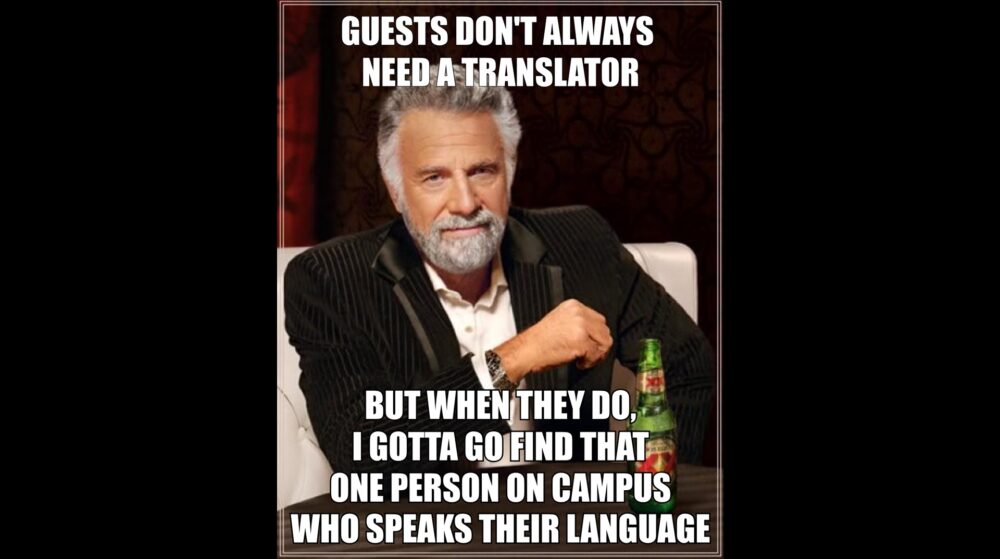
That’s why this week’s newsletter meme resonates with leaders at colleges and schools. The typical response is to find someone on staff or on-site who happens to speak the language. They’re trying their best. But that’s not sustainable, scalable, or capable of meeting every need that walks through the door.
The “does anyone in the building speak [language]?” approach is a real solution to the problem in the same way a spare tire is a real solution to a flat, assuming you have one. It gets you to the next exit, but it’s a lot of work, and you need a real tire you can rely on in the long run.
But the deeper cost isn’t logistical.
It’s that people stop feeling like they belong when they can’t understand what’s being said in the room.
It’s the parent who can’t engage at the school board meeting and has to wait for the online minutes to run them through an online translator later. It’s the student who has to interpret for their own parents during a college tour, unable to simply enjoy the same visit as everyone else. It’s the grandmother who traveled thousands of miles for a graduation ceremony she can’t fully be part of.
They didn’t just miss information. They missed feeling welcome. They missed the chance to belong because the room wasn’t built for them.
For most of American history, that gap has felt unsolvable. There are too many languages, too little time, too small a budget. But it’s worth noting that the same forces and technologies improving how we connect with each other are quietly closing that gap for in-person events, too. Not through a bigger interpreter budget, but by explicitly designing for everyone to belong.
Because we all belong in e pluribus unum.
The organizations that figure this out first won’t just be the most accommodating. They’ll be the most connected to the people and communities they’ve always claimed to serve.
That’s a problem worth solving. And it’s closer to being solved than most people think.
In the next issue…
We’ll take a deeper look at the meaning of “belonging” and how to make everyone feel like they belong in the room.
Have a gathering that went surprisingly well or one that taught you something the hard way? We’re always looking for stories and voices to feature in Gathering Points. Reach out any time.
Get the next issue of Gathering Points.