
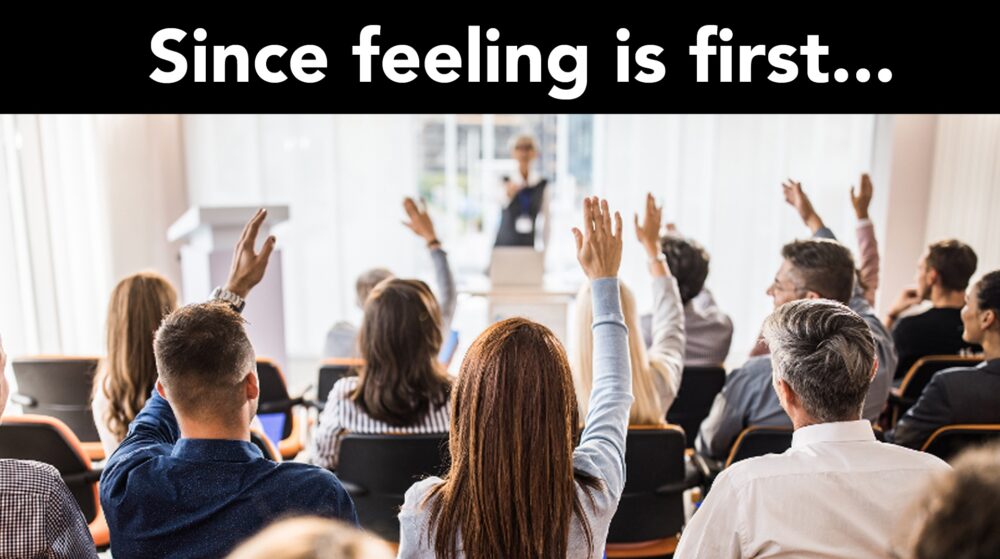
If you’ve ever visited a college and taken a guided campus tour as a prospective student or with one, would you say it felt more like a museum tour or more like a great first date? And which feeling do you think colleges would prefer prospective students to have?
We’ve all been to countless in-person gatherings in our lifetimes: school classrooms, team meetings, board meetings, religious services, camps, retreats, conferences, town halls, campus visits, weddings, graduations… You get the idea.
The people who organized those gatherings had plans and goals for you and other attendees. Take a moment to reflect on how you felt at those gatherings – passive, engaged, welcome? Whether or not organizers set goals for how attendees will feel, every attendee feels a certain way before, during, and after an event. Colleges want prospective families to feel like the campus visit was a great first date, but the design of many visits feels more like a museum tour.
We’ve spent much of our time in recent issues talking about how planners and leaders can improve meetings and gatherings. But we haven’t always looked at those efforts through the eyes of attendees. This issue kicks off a five-part series on the four types of in-person gatherings, defined by the impact on attendees, that also serve as four stages on the transformation journey for any event that needs to improve.
TL;DR – here are the four gathering types as stages on the transformation journey based on how they make attendees feel:
- Presenting – “They’re telling me the same stuff they tell everyone.”
- Inviting – “They stopped to ask me a question.”
- Engaging – “They care what I think.”
- Belonging – “They care how I feel.”
Over the next four issues, we’ll explore each stage in depth. For this introduction, I’ll simply share examples of:
- Positive things attendees might say after a gathering at this stage
- Negative things attendees might say after a gathering at this stage
- When it’s likely appropriate for a gathering to be at this stage
- When it’s not appropriate for a gathering to be at this stage, and therefore that gathering needs to be on a transformation journey to a higher stage
The extent to which any particular gathering needs to be transformed depends on its goals, context, and the attendees.
Stage 1: Presenting
Attendees feel they were passive receivers during the gathering.
Positive Things Attendees Might Say
- “I appreciated everything that was shared.”
- “That presentation was excellent.”
Negative Things Attendees Might Say
- “They’re just telling us information that I’ve already read on the website.”
- “This meeting could’ve been an email.”
Appropriate Gatherings at This Stage
- A graduation, gala, or award ceremony
- A conference keynote
Inappropriate Gatherings at This Stage (it needs to be at a higher stage)
- A prospective student’s college visit and guided campus tour
- A first date
Stage 2: Inviting
Attendees feel there was a chance for someone to share a thought or ask a question.
Positive Things Attendees Might Say
- “There was enough time for people to ask questions.”
- “I’m glad they didn’t just talk at us the whole time.”
Negative Things Attendees Might Say
- “I don’t think they really care what anyone in the audience has to say.”
- “They only left time for two pre-drafted questions, and those weren’t really the questions we were all wondering about.”
Appropriate Gatherings at This Stage
- A college financial planning introductory overview meeting for families of 11th graders
- A docent-led museum tour that takes questions
Inappropriate Gatherings at This Stage (it needs to be at a higher stage)
- Team brainstorming or planning sessions
- Parent-teacher conferences
Stage 3: Engaging
Attendees feel their thoughts matter.
Positive Things Attendees Might Say
- “They really listened and care what I think.”
- “The Q&A time was a real conversation with true back and forth, not just a verbal FAQ.”
Negative Things Attendees Might Say
- “The conversation was great, but I didn’t feel I really connected.”
- “I had a great time, but I feel like an outsider.”
Appropriate Gatherings at This Stage
- Town hall meetings for municipalities, governments, elected officials, school districts
- Routine team or company meetings where incremental change is happening, such as going over the new health plan options before Open Enrollment
Inappropriate Gatherings at This Stage (it needs to be at a higher stage)
- Orientation for new students or new employees
- A team meeting after a conflict, a loss, or a hard decision
Stage 4: Belonging
Attendees feel like they matter and their feelings matter.
Positive Things Attendees Might Say
- “They care how I feel.”
- “I feel like I belong.”
Negative Things Attendees Might Say
- “It felt forced. I just wanted the information.”
- “That was too much personal sharing for a work meeting.”
Appropriate Gatherings at This Stage
- A prospective student’s college visit and guided campus tour
- When a major change is happening at a company – layoffs, restructuring, new strategic direction, new leadership
Because Stage 4, Belonging, is the deepest stage for gatherings, there’s nowhere else to go from there.
In the next issue…
We’ll dig into Stage 1 of the in-person gathering transformation journey and expand on when Presenting is exactly the right approach and attendees leave satisfied. While presence alone can’t drive participation, not every gathering needs the same level of participation.
Have a gathering that went surprisingly well — or one that taught you something the hard way? We’re always looking for stories and voices to feature in Gathering Points. Reach out any time.
Get the next issue of Gathering Points.