
Part 2 of 2: The Solutions
“Stop Asking What Information to Deliver. Start Asking What Experience to Create.”
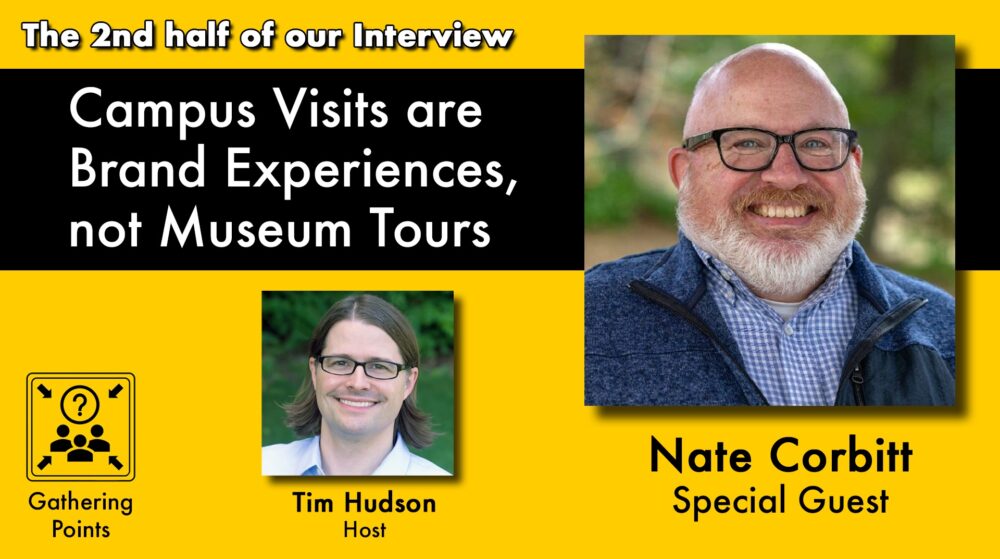
In the first half of our conversation with Nate Corbitt, Campus Visit Manager at UNC Asheville, we explored the pain points keeping campus visit experiences stuck in the past including information overload and the tendency to treat visits as a logistical function rather than a strategic enrollment one. This week’s newsletter is the second half of the interview where Nate shares what changed his thinking, what he learned, and what he’d tell anyone still designing campus visit events the old way.
Tim Hudson: In terms of solutions… You offered some in your article, which we’ll link when we post this. Give us more detail about when you first realized the accepted way of doing campus visits wasn’t working.
Nate Corbitt: I think it goes back to my first admitted student day as visit manager – the first event I had planned entirely on my own. I thought I had checked all the boxes. Great data, great guest speakers, great panels. I thought I had done everything by the book. But I wasn’t looking at it from the standpoint of how these students would feel – whether we were throwing too much at them, whether it was too much data.
This was prior to COVID, and COVID actually clarified something: a lot of what we were trying to cram into one day, we could start offering as virtual sessions in the evenings. We still do that today. We can offer a full virtual webinar on financial aid that anyone can attend – including people who didn’t come to Admitted Student Day. So we don’t have to throw everything at them at once. We can spread it out so the person isn’t overwhelmed on the day that really matters – the day we want them to picture themselves on our campus as students, not thinking “I’ve got all this information to process.” We want them to be present on campus and really get comfortable there.
Tim: Did you go through a process of whittling things down? I can imagine saying, “Here are all 1,000 things we think we should say – if we could only say one, what would it be?” And it probably wouldn’t be about class size. It would be about what makes you distinct and unique. Because if everything is important, then nothing is. Is there anything you feel like you saw earlier than others did about this problem?
Nate: I don’t necessarily think I saw it earlier than anyone else, but I did start to realize early on that students trust what they experience more than what they’re told. When I understood that the experience was probably one of the biggest factors in whether they’d even apply, it changed how I looked at everything – the tour guides, the pacing of the tour. I once went on a tour at another school that was over two hours long. I get that you’re trying to fit everything in, but that’s just too long.
So I started looking at pacing differently, the energy of tour guides, their storytelling. We actually have a story bank that our ambassadors can look through. If we have a newer ambassador – we do allow some freshmen to sign up as tour guides, though usually not until second semester – and they don’t have their own stories yet, they can go through that story bank and share a story from a fellow ambassador: someone who did undergraduate research, or performed in the music program, whatever it might be.
I even started looking at parking and signage differently. All of these little things communicate institutional values, and we want every one of them to do that.
Tim: A little story goes a long way. We’re wired for them. The story bank is a great idea.
What would you tell someone who’s still stuck in the old ways of doing things?
Nate: Stop only asking, “What information are we trying to deliver?” Start asking, “What experiences are these students actually having on our campus?” That one shift in mindset can change a lot.
Tim: That is what Gathering Points is all about. Too often we plan events prioritizing who’s doing the speaking, what we’re saying, where we’re taking people – but we really need to prioritize events from the perspective of the listener, the visitor, the experience. That’s a great, simple framing.
Last question – and I’m sure people are going to want to know about the homemade gourmet small batch barbecue rubs. What’s next, and what do you like most about it?
Nate: I’ve got six different flavors now. It all started when COVID hit and we were all stuck at home. The store-bought rubs just weren’t doing it for me, so I started experimenting and giving them to friends when I thought they were ready. Everyone said I should try to sell them. I figured, “I’ve never owned my own company before, how hard could it be?” We won’t get into that…
The next one I’m working on is a cherry and chipotle mixture. I got the idea from a Buc-ees of all places. They had a cherry beef jerky, and I thought that would probably go really well with chipotle, something with some heat. The other one I’m thinking about is an Asian-inspired rub with soy, ginger, garlic, and some brown sugar to give it more of a teriyaki flavor. It takes a lot of testing before I’m ready to put something on the market, but those are on the drawing board.
Tim: Those sound great! Well, thank you, Nate. Everyone, we’ve been talking with Nate Corbitt, Campus Visit Manager at the University of North Carolina Asheville by day, and creator of those small batch dry rubs by night.
Thank you all for listening, and thank you, Nate, for being part of this Gathering Points community that is just getting started, powered by Campus Pro Events. Whether you’re an educator, a leader, an event planner, or someone who just wants to make in-person gatherings more engaging and inclusive, subscribe to our newsletter on LinkedIn so we can learn and share together. We’re always looking for stories and voices to feature in our interviews and newsletters. If you had a gathering that went surprisingly well – or one that taught you something the hard way – we’d love to share your story. Reach out anytime.
Nate Corbitt is the Campus Visit Manager at the University of North Carolina Asheville. Find his article The Case for Campus Visit and Event Consulting: The Most Overlooked Lever in Enrollment Strategy on LinkedIn.
Have a gathering that went surprisingly well – or one that taught you something the hard way? We’re always looking for stories and voices to feature in Gathering Points. Reach out any time.
Get the next issue of Gathering Points.