
Part 1 of 2: The Pain Points
“The Campus Visit Is Not a Tour. It’s a Lived Brand Experience.”
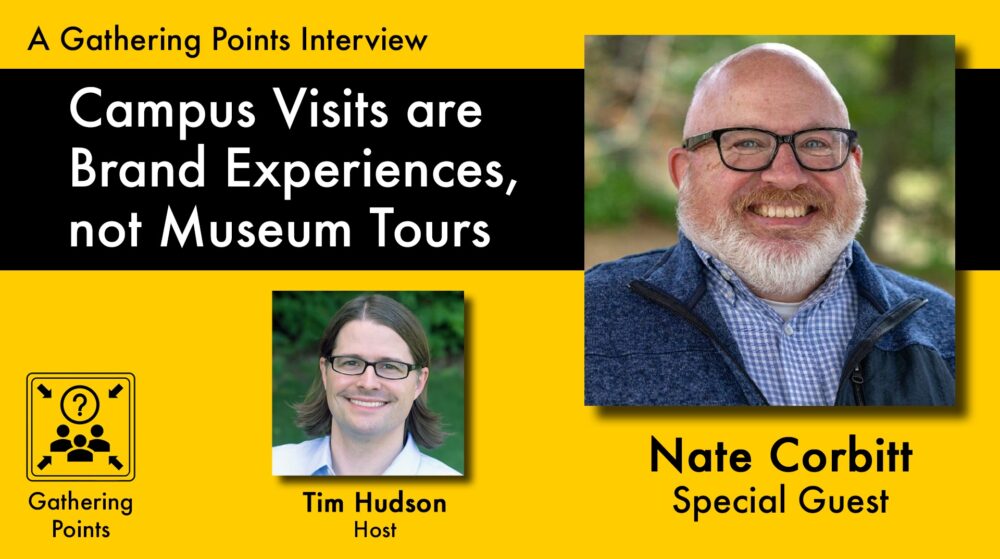
Welcome to the first interview for Gathering Points, a new community and newsletter on LinkedIn powered by Campus Pro Events. I’m Tim Hudson, the newsletter’s author, and I’m really excited for Gathering Points to be a space for shared learning as we find better ways to design in-person events. We know people are always going to gather in person. Most of us prefer it. But most events assume that being in person is enough. Too often, presence alone can’t drive participation. Too many events are planned for what gets said, not for who’s listening. They’re too often inaccessible, unengaging, and forgettable by default. So if it’s worth getting together in person, then it’s worth having more than just a mic and a PowerPoint.
I’m really excited for this first conversation. Joining us is Nate Corbitt. He’s the campus visit manager at the University of North Carolina Asheville by day, and a purveyor of homemade gourmet small-batch barbecue rubs by night. We’ll talk about that in a little bit, Nate. Welcome!
Nate Corbitt: Thank you, thank you for having me. I appreciate it.
Tim: Nate has over two decades working in campus visit and recruitment events, so he knows a thing or two about designing in-person gatherings. And not just any gatherings: some of the highest-stakes, life-changing events. When you visit a campus, that visit is wildly important. For students and families, you’re making a life choice about where to spend the next few years. And 86% of university enrollment leaders believe that campus visits are extremely important to students’ decisions to enroll. So these are high-stakes gatherings.
A few weeks ago, Nate wrote a provocative, insightful article on LinkedIn titled The Case for Campus Visit and Event Consulting: The Most Overlooked Lever in Enrollment Strategy. The stories he told and the insights he shared about how to make that event powerful. I thought, “Nate is the perfect guest for this first interview because that perspective is exactly what Gathering Points exists for.”
As some of you know, Campus Pro Events used to be called Campus Pro Tours, because it was campus tours with my son that led me to think there’s got to be a better way. It still felt like a sit-and-get museum tour. It hadn’t really changed much in decades. So when I read Nate’s article, it felt like he was talking directly to me. Nate, with that introduction, thank you for joining.
Right out of the gate in your article, you dropped something that might sound obvious but I’m sure caused a lot of lightbulb moments. You said: “The campus visit is not a tour. It’s a lived brand experience.” Share a bit about your journey and what led you to that realization.
Nate: I’ve been at this close to two decades, about 19 years now. Back when I started, I took over for somebody and was doing everything the way they used to do it, the way the university had always done it. And then several years in, I started looking at the faces of the people at my events rather than just checking the itinerary. What I noticed was that people looked overwhelmed. We were throwing too much information at them all at once.
So I started asking: “what do we actually want these students to feel when they leave?” We want them to feel like they belong. We want them to feel comfortable on our campus. We want them to think, “I can be a student here.” That started to matter more to me than how much information we delivered.
It really hit home when I took my own daughter on a campus tour. During the info session, they talked so much about small class sizes, but they never explained what those small class sizes actually do and why it’s good to have them. When I give my info sessions, I don’t just say we have small classes. I talk about building relationships with professors and that connection so students have a resource when they graduate, when they’re doing research, when they need recommendations. We want them to see that, not just hear a data point.
Tim: So many times the design question is: how do we get them to know a bunch of stuff instead of feel a bunch of stuff. And if they leave feeling overwhelmed, maybe they worry they’ll be overwhelmed as a student there. Your small class sizes point is a great insight, because if you’re not explaining the why behind it, you’re making assumptions. That’s one small thing I’ll be thinking about all day.
So as a quick follow-up: did you end up trimming the information you were providing? What were some tangible impacts?
Nate: The biggest change was with our open house. We had a very structured open house where students would go from one panel to the next, one session to another. A few years back, I decided to change it to a true open house: let students go where they wanted to go and see what they wanted to see, rather than guiding them through a prescribed process.
We still offered those sessions, but we gave students about a three-hour window in the middle of the day and offered sessions at different times. If a student wanted to attend one, great. We opened up residence halls so they could see one, or two, or three. Whatever they wanted. Academic departments opened their doors, and if a student wanted to go into a specific department, they could.
That allows them to not feel overwhelmed by everything we’re throwing at them. They get the information they actually want. And I think they leave campus feeling a lot more comfortable because I don’t think there’s a student out there who’s going to say, “I chose that school because of their PowerPoint presentation.” But being able to go to those open sessions, see students walking around, go into departments and classrooms… That lets them picture themselves there.
Tim: And you can say, “We give you lots of options here as a student,” and if you’re giving them options during the visit, you’re already living that message. It reminds me of taking my middle schooler to a museum on a day off. You can’t see the whole thing — it’s overwhelming. But when we picked the things we actually wanted to see, it was a completely different experience. Glad you gave them that chunk of time.
Let’s get into the pain points. The uncomfortable truths. Things we don’t always say out loud, things we kind of assume are working. What’s something everyone who works in college visits says is working, but you know isn’t?
Nate: I think it goes back to what I was just talking about: the idea that more information is better. But that’s not always the case. A lot of universities and visit programs believe that if they just give students and families enough information, they’ll make the right decision. But you get to some of these events and they’re overloaded with data, presentations, sessions, and panels because universities are afraid to leave anything out. They want to cover everything. But that doesn’t leave students confident. It leaves them exhausted.
Tim: Doesn’t leave them comfortable. Leaves them exhausted. That’s it. It reminds me of the phrase “this meeting could have been an email.” I sometimes feel like certain campus visits could have been a website. If you’re just throwing all the info at someone, what’s the point of gathering in person?
What do people who work in campus visits avoid talking about because it would kind of look bad?
Nate: A lot of folks don’t want to change. They’re very resistant to it. One of the worst things you can hear — in campus visits or anywhere else — is “we’ve always done it this way.” A lot of campus events are designed around how they’ve always been done. And there’s an internal politics element too: different departments want to be a big part of these events when a lot of them don’t necessarily need to be. When you do that, students don’t feel connected. They feel emotionally drained.
Tim: So there’s a hesitancy to talk about new possibilities because it might imply that what we’ve been doing isn’t working. Or a reluctance to admit that inertia is really why we keep doing it.
Nate: Right. And I actively seek feedback from the faculty and staff who help with our events every year, because if something’s not working, I’m more than happy to change it. Our events probably shift direction every couple of years. We might add a presentation here or take out a session there. I don’t like being stagnant.
Tim: Feedback’s a gift. You mentioned noticing students’ eyes glazing over. That’s a meaningful signal. If you have an insight telling you there’s room for improvement, you can try something new and see if it worked.
What do you think colleges have completely misunderstood about campus visits and events?
Nate: Higher education tends to treat campus visits and events as strictly logistical, instead of as a strategic enrollment function. The visit is where the institutional brand becomes real for students. Students aren’t coming to campus just wanting to hear facts or evaluate buildings. They’re asking themselves: Do I belong here? Can I see myself here? Do these people care about students like me?
That opens up a completely different lens than just running tours. You have to look at it from a psychological and emotional standpoint. The campus visit can be just as important an enrollment function as anything else.
Tim: That’s a big deal. To misunderstand it as a matter of logistics. Of course people want to see the place where they might spend the next several years. But to only treat it as “we’re going to show them some stuff and tell them some stuff,” instead of recognizing: this is our moment. We have a chance right now to make them feel like they belong. It is that brand experience.
This reminds me — I think it was Aristotle who noted that people make decisions based on logic, emotion, and their social group. What does mom think? What do my peers think? That emotional aspect matters so much more than the data points. Past a certain point, comparing class sizes doesn’t mean anything. It’s the feeling.
In the next issue…
Well share Part 2 of our interview with Nate as he shares what shifted his approach, including a story from his very first admitted student day, how COVID unexpectedly improved the campus visit experience, and the single mindset shift he’d recommend to anyone still designing events the old way.
Have a gathering that went surprisingly well — or one that taught you something the hard way? We’re always looking for stories and voices to feature in Gathering Points. Reach out any time.
Get the next issue of Gathering Points.